604.506.5068
5 Quick Wins to Automate Administrative Tasks with AI — Without Changing Your Systems
Unlock real productivity gains by layering AI on top of the ERP, CRM, and spreadsheet tools your team already uses.
For many organizations, “AI transformation” still sounds expensive, disruptive, and technically overwhelming. Leaders know that AI can streamline operations and reduce administrative workload, but they hesitate because they assume it requires new systems, complex migrations, or a complete overhaul of existing infrastructure.
The good news: you don’t need to change your ERP, CRM, or internal tools to benefit from AI today. The fastest wins come from AI solutions that layer on top of your current systems and automate the repetitive manual work that slows teams down.
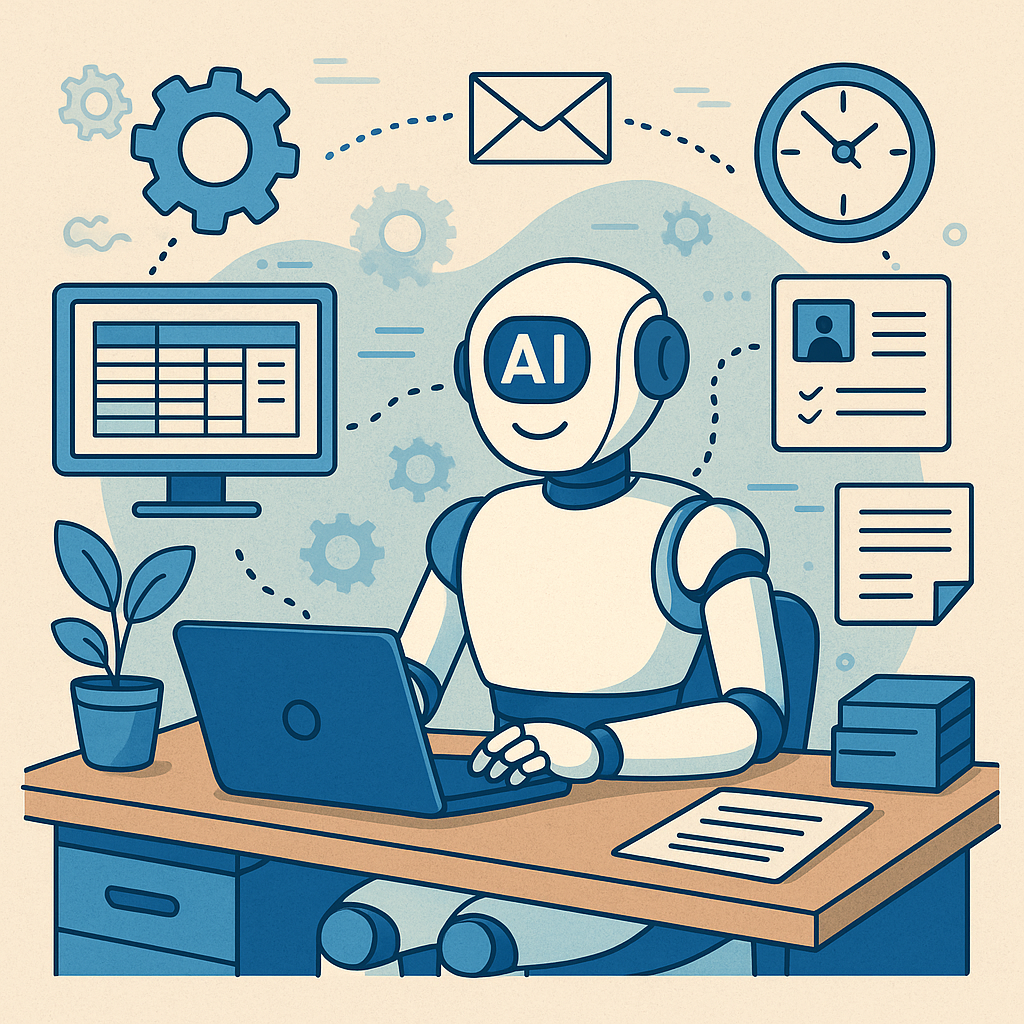
⚙️Designed to plug into ERPs, CRMs & spreadsheets
Why “No-System-Change” AI Matters
Companies often postpone AI adoption because of legacy systems, internal resistance to change, budget concerns, fear of interrupting mission-critical operations, or limited IT capacity. But modern AI tools don’t demand a full rebuild of your tech stack.
Instead, they integrate via API connectors, browser extensions, email automation, low-code workflow builders, and direct add-ons for platforms like Excel, Google Sheets, Salesforce, HubSpot, or SAP. That means you can unlock meaningful efficiency gains without migrations or large rollout projects.
- Your ERP, CRM, and spreadsheets
- Your core workflows and processes
- Your data ownership and structure
- Who (or what) does the repetitive administrative work
- How quickly information moves between systems
- The amount of time your people spend on low-value tasks
5 Quick Wins You Can Implement Right Now
Below are five practical, low-friction ways to automate administrative tasks with AI. Each is designed to work with your existing ERPs, CRMs, or spreadsheets—not replace them.
1. Automatic Data Entry & Syncing Between Systems
Administrative teams spend countless hours copying data between spreadsheets, ERPs, and CRMs. AI-powered connectors can safely automate this work and dramatically reduce human error.
How it works: AI reads information from emails, forms, PDFs, or spreadsheets and pushes it into the correct fields in your ERP or CRM.
- Create or update CRM records when a web form is submitted.
- Send spreadsheet data into SAP or Oracle without manual entry.
- Generate new vendor profiles from PDF onboarding documents.
Impact: Hours of copy-paste work disappear, and your data becomes more consistent and reliable across systems.
Document-heavy workflows—like handling invoices, contracts, or compliance forms—are still a major bottleneck. AI can now read, classify, and extract information from documents stored in your existing email, folders, or shared drives.
What AI can do:
- Extract structured data from invoices and send it to your finance system.
- Classify and tag contracts based on risk, renewal dates, or type.
- Summarize long reports so teams can act faster on the key points.
Impact: Manual document review turns into a fast, repeatable workflow that your teams only need to supervise, not perform line by line.
3. AI-Assisted Customer Communications & Follow-Up
Email drafting, follow-ups, and meeting notes quietly consume a huge portion of each workday. AI assistants now integrate directly into Outlook, Gmail, and CRM tools to lighten that load.
How this looks in practice:
- AI drafts a response to a client email inside Outlook based on previous conversations stored in your CRM.
- After a call, AI generates a meeting summary and pushes it into the contact record.
- First-level customer inquiries receive AI-assisted replies that your team can approve with one click.
Impact: Teams maintain consistent, professional communication while reclaiming hours each week for higher-value, relationship-focused work.
4. Automated Reporting & KPI Dashboards
Many organizations still assemble reports manually from multiple systems and spreadsheets. AI can pull the data together, update dashboards, and even add written commentary.
AI can:
- Connect to your ERP, CRM, and spreadsheets to refresh metrics on a schedule.
- Generate natural-language summaries that explain trends and anomalies.
- Prepare weekly or monthly performance snapshots for leadership without manual work.
Impact: Reporting becomes proactive and consistent, giving stakeholders real-time visibility without burdening operational teams.
5. Smarter Workflow Automation for Approvals & Requests
Approval workflows—vacation requests, purchase orders, expenses, onboarding, IT access—tend to be repetitive and slow. AI and low-code tools can orchestrate these flows using data from your existing systems.
Examples:
- AI routes incoming requests to the right manager based on role, department, or budget.
- Forms are checked automatically for missing or inconsistent information before entering your ERP.
- Onboarding checklists are generated for each new hire, drawing from HR templates you already have.
Impact: Bottlenecks shrink, cycle times improve, and teams enjoy clearer, more reliable processes.
From “Big Transformation” to Small, Smart Experiments
The smartest AI strategy right now is not about replacing your ERP, CRM, or spreadsheets. It’s about augmenting them. Start with small, low-risk experiments where administrative effort is high and the rules are clear.
Each quick win builds internal confidence, proves ROI, and creates momentum for broader adoption—without forcing a disruptive system change.